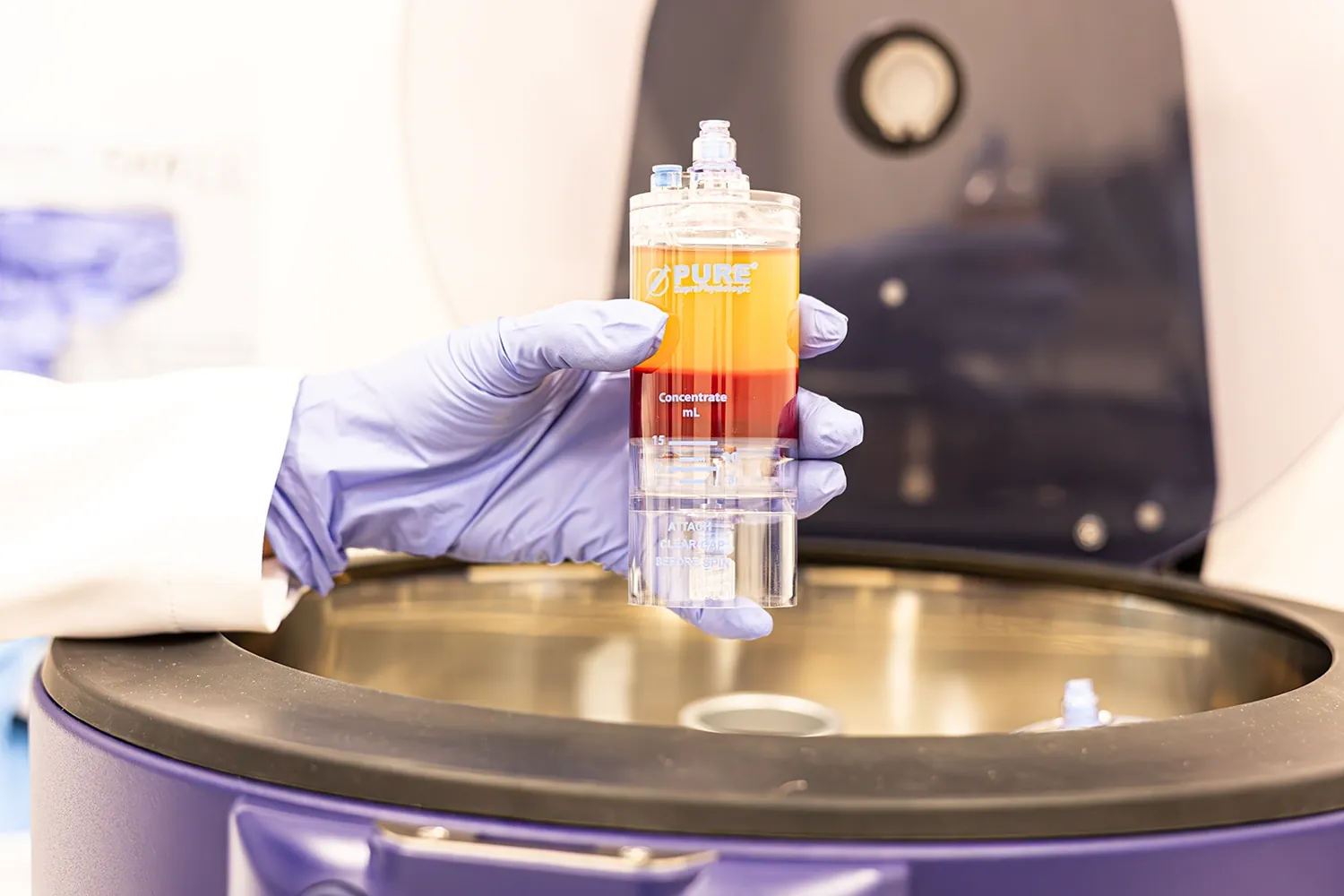
PRP — your own platelets, placed where repair needs to start.
Orthopedic platelet-rich plasma: autologous, image-guided, and judiciously applied — for joints, tendons, and ligaments, not cosmetics.
What is PRP?
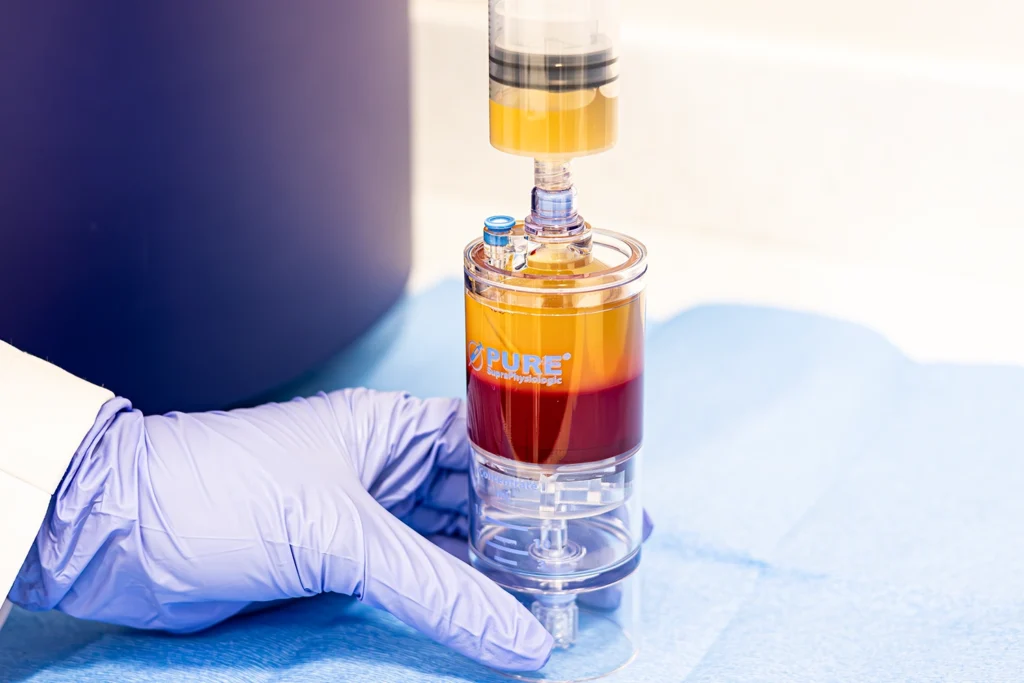
Platelet-rich plasma is made from your own blood. A small draw is spun to concentrate the platelets — and the growth factors they carry — into a small volume, then placed where repair needs to start. Because it’s your own biology, it has a long safety record and introduces nothing foreign.
But “PRP” is not one thing. It names a wide range of preparations that vary enormously between clinics — in how the blood is concentrated, in what actually ends up in the syringe, and in how precisely it’s placed. Whether it helps depends on that whole chain: the right patient and the right injury, the concentration method and system, and placement exact enough to reach the tissue that needs it.
What it treats
This is orthopedic PRP — placed in joints, tendons, and ligaments to support repair. It’s considered for:
- Tendinopathy — tennis and golfer’s elbow, patellar and Achilles, gluteal tendon
- Osteoarthritis — mild to moderate, especially the knee
- Ligament and labral injury — including the shoulder and hip
- The unstable, pain-prone joints of hypermobility and Ehlers-Danlos
An accurate diagnosis decides whether it’s the right tool for your injury — that’s what a first evaluation is for.
Placement is key to the result
The best-made PRP does nothing in the wrong spot. Dr. Paul has spent more than fifteen years refining ultrasound-guided injection — and directs a Stanford Healthcare sports-medicine fellowship where he teaches it — so the platelets reach the exact structure that needs them: a precise point on a tendon, a specific plane of a joint, sometimes woven through individual fibers. It’s meticulous work, closer to surgery than to a shot in the arm.
We measure what’s in the syringe
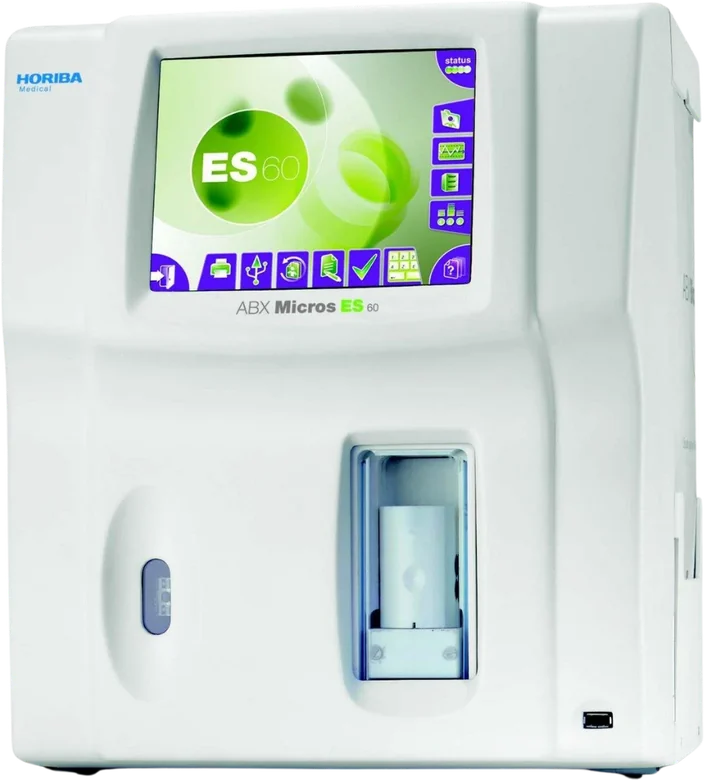
Most PRP is a black box — drawn, spun, injected, with no record of what was actually delivered. Here the platelets are concentrated on the EmCyte AspiraDome system, and every case is run through a cell counter before anything is placed. We record the platelet dose, the concentration against your own baseline, the white-cell makeup — leukocyte-rich, neutrophil-rich, or monocyte-rich — and the hematocrit.
That’s the difference between a defined treatment and a black box: you know exactly what was delivered.
Common questions
Asked and answered
What makes one clinic’s PRP different from another’s?
More than the machine. It starts with the diagnosis — if the real cause of the pain isn’t found, even a perfect injection targets the wrong thing. Shoulder pain, for instance, can come from the shoulder, from how the thoracic spine moves above it, or from hypermobility in the surrounding structures; a thorough evaluation reads the injury in context and treats both the symptom and the cause. From there it comes down to the preparation — concentrated and measured on a cell counter, not estimated — and the placement, which is ultrasound-guided and often combined with nerve hydrodissection or fascial work to free stuck tissue and restore motion.
Does PRP work?
For the right patient, it can work well — some people with stubborn tendon and joint problems, including complex injuries, have had excellent results. It doesn’t help everyone, and it’s used only where the diagnosis supports it. It’s also rarely all-or-nothing: PRP is often one part of a plan that may include hyaluronic acid to cushion an arthritic joint, nerve hydrodissection, or targeted rehabilitation. Dr. Paul is a published author on PRP methodology in The Journal of Arthroplasty (2025).
Is a PRP injection painful?
The injection itself is quick, and comfort is planned for. Dr. Paul offers nitrous oxide, oral sedation, and advanced regional and specific peripheral nerve blocks — an approach few physicians offer — alongside breath work, meditation, and procedural music tuned to 528 Hz. Because PRP works by prompting a healing response, it’s normal to feel some soreness or ache at the site for a few days afterward — that’s the process starting, not a setback.
How soon can I return to activity after PRP?
Recovery depends on the injury. After your procedure, Dr. Paul evaluates your case and gives you personalized instructions for returning to activity — what to ease off, and for how long.
How many PRP injections will I need?
It depends on the problem and how you respond. Some conditions settle with a single well-placed injection; others do better with a short series. Because every dose is measured, we know exactly what was delivered if a follow-up is considered.
How long does PRP take to work?
PRP isn’t an instant fix — it stimulates repair over time. Many people begin to notice change over several weeks, with continued improvement over the following couple of months as the tissue responds.
Is PRP covered by insurance?
For orthopedic use, PRP is generally considered elective and is usually not covered by insurance or Medicare. Cost is discussed openly at your evaluation.
How is the PRP dose measured?
Every case is run through a cell counter before it’s placed. We record the platelet dose, the concentration against your own baseline, the white-cell profile — leukocyte-rich, neutrophil-rich, or monocyte-rich — and the hematocrit, so you know exactly what was delivered.
Dr. Paul in the literature
Selected peer-reviewed work
- Everts PA, Malanga GA, Paul RV, Rothenberg JB, Stephens N, Mautner KR. Assessing clinical implications and perspectives of the pathophysiological effects of erythrocytes and plasma free hemoglobin in autologous biologics for musculoskeletal regenerative medicine therapies. Regen Ther. 2019;11:56–64. doi.org/10.1016/j.reth.2019.03.009
- Sussman WI, Buford DA, Bowers RL, Paul RV, Latzka EW. Letter regarding “Platelet-Rich Plasma Injections Are Inferior to Corticosteroid Injections for Short-Term Pain Relief.” J Arthroplasty. 2025;40(8):e52–e54. doi.org/10.1016/j.arth.2025.05.007
Educational information, not medical advice or a diagnosis. Care is individualized; not every treatment is right for every patient, and results vary.