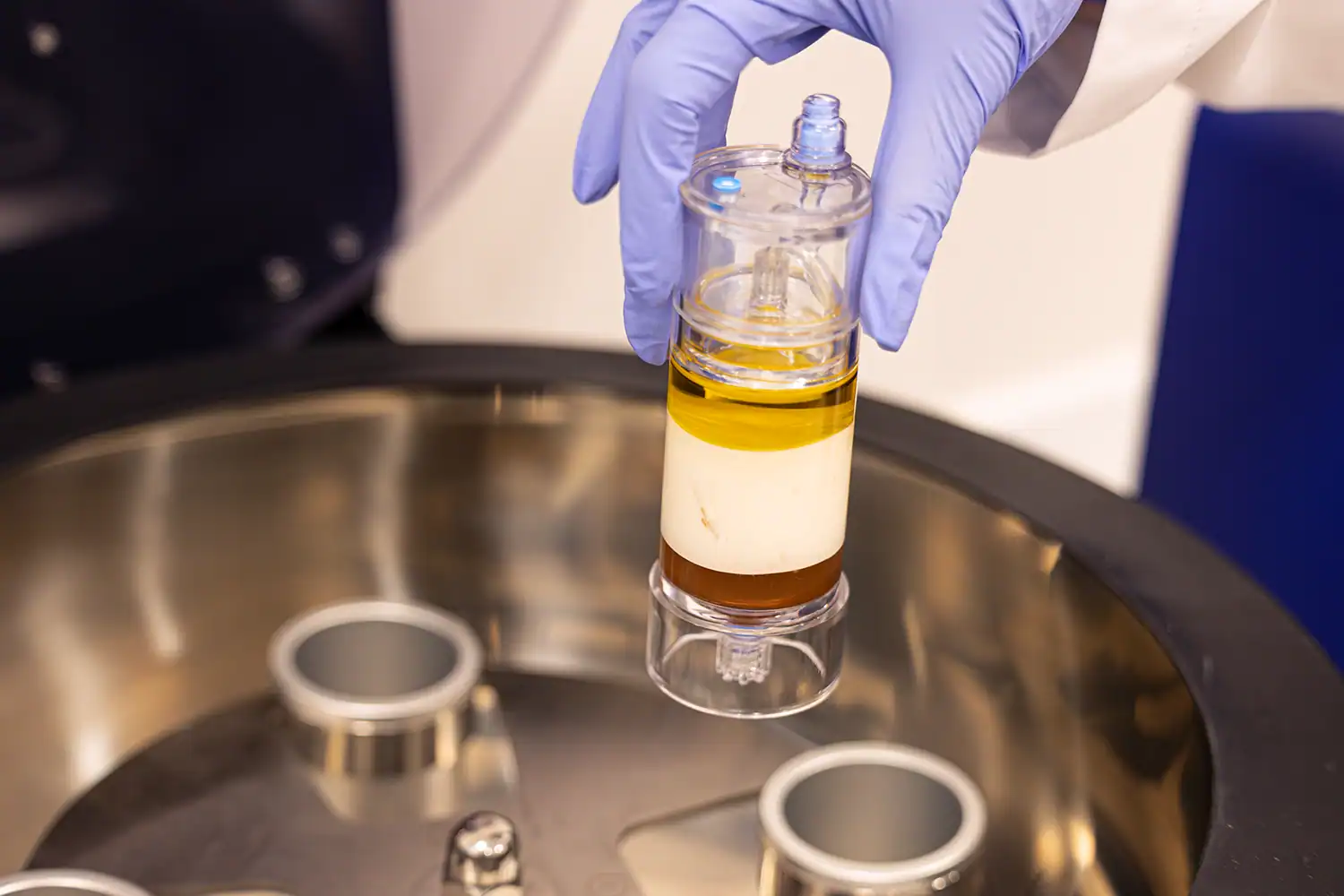
Micronized lipoaspirate — your own tissue for cushioning and support.
A structural fat graft, processed from your own adipose tissue and placed precisely — autologous and minimally invasive.
What is micronized lipoaspirate?
Micronized lipoaspirate — also called adipose or fat grafting — is made from a small sample of your own fat, processed into a fine structural graft. Fat is a natural cushioning tissue, and here it’s used for exactly that: to pad and support a joint or soft tissue that has lost its own padding. Because it’s autologous, it introduces nothing foreign.
How the graft is made
How your fat is processed changes what it can do. A small amount is harvested, then refined on the EmCyte Progenekine and Mini-TC system into a micronized graft — fine enough to place through a needle, structured enough to cushion. Dr. Paul then places it under image guidance, so it reaches the exact structure that needs support. It’s minimally invasive, done in a single visit.
What it treats
Micronized lipoaspirate is used for orthopedic joint and soft-tissue problems where cushioning and support are what’s missing — most often osteoarthritis of the knee and other load-bearing joints. Hyaluronic acid — a cushioning gel injected into an arthritic joint — is sometimes used alongside it or in its place. It’s matched to the diagnosis, so an evaluation determines whether it fits your case.
Chosen carefully
For the right joint, your own fat is a direct way to put cushioning back where it has worn away — a targeted, minimally invasive graft of your own tissue, placed exactly where the support is missing. Dr. Paul offers it when the diagnosis and the mechanism fit, and is candid that the evidence is stronger for some cases. His selectivity is supported by his outcomes data.
Common questions
Asked and answered
What is micronized lipoaspirate?
It’s a structural graft made from a small sample of your own fat, refined and placed to cushion and support a joint or soft tissue. You may see it called adipose grafting, fat grafting, or MFAT (micro-fragmented adipose tissue).
Is this the same as Lipogems?
They’re in the same family. Lipogems is one branded system for preparing micro-fragmented fat; here the graft is prepared on the EmCyte Progenekine and Mini-TC system. The goal is the same — a clean, structural fat graft placed precisely — and Dr. Paul picks the approach he believes is best for you.
Fat grafting or PRP — what’s the difference?
They do different jobs. PRP delivers a concentrated dose of your own growth factors to signal repair; a fat graft adds structure — cushioning and support — from your own tissue. Some patients are candidates for one, some for the other, and the diagnosis decides.
Does it work for knee osteoarthritis?
For the right knee, at the right stage, adipose grafting can add cushioning where the joint has lost it. The evidence is still developing and it isn’t right for everyone — Dr. Paul offers it where the diagnosis supports it, as part of a plan built around your knee.
How much does it cost?
Adipose grafting is generally elective and usually not covered by insurance. Cost is discussed openly at your evaluation, once it’s clear whether it’s the right tool for your joint.
What is recovery like?
It’s a minimally invasive, in-office procedure. Recovery depends on the harvest and treatment sites, so Dr. Paul gives you personalized aftercare for your case.
Educational information, not medical advice or a diagnosis. Care is individualized; not every treatment is right for every patient, and results vary.