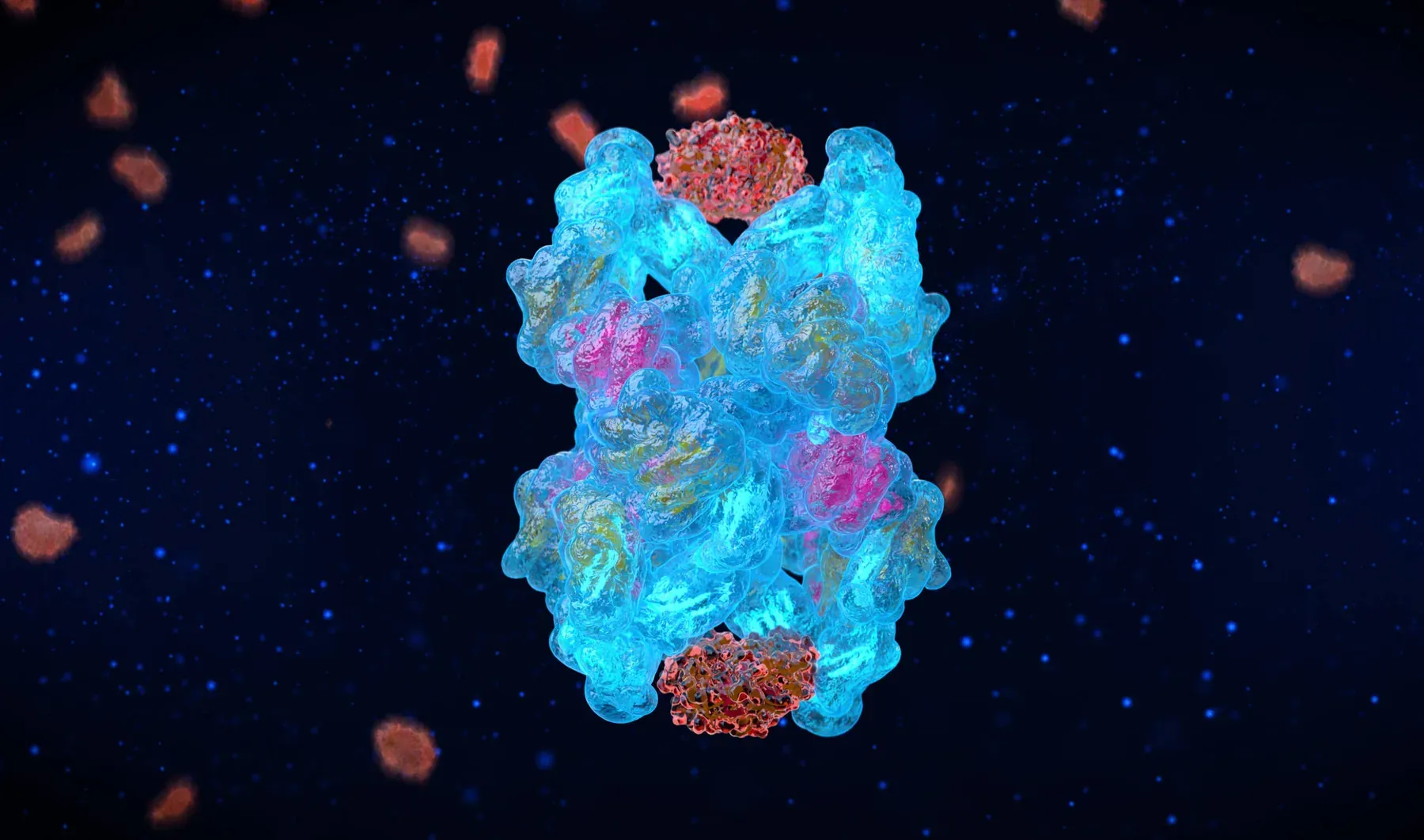
A2M — a natural enzyme inhibitor, placed in the joint.
Alpha-2-macroglobulin: a protein your own blood already makes that traps the enzymes breaking down your cartilage — concentrated, then placed in the joint under image guidance.

What is A2M?
Alpha-2-macroglobulin (A2M) is a protein your blood already makes. Its role is to trap and neutralize enzymes — including the ones that break down joint cartilage. A2M therapy concentrates that protein from your own plasma and places it where the damage is happening. Because it’s autologous, it introduces nothing foreign, with virtually no risk of rejection or allergic reaction.
How it works
A2M works as a molecular trap: it binds the cartilage-degrading enzymes (proteases) that drive osteoarthritis and locks them away, so they can no longer do their damage. To make a dose worth placing, the protein is concentrated from your plasma on the Cytonics APIC system with EmCyte CORE ultrafiltration, then delivered into the joint under ultrasound guidance so it reaches the exact structure that needs it.
What it treats
A2M is used for joint problems where those cartilage-degrading enzymes are part of the picture — most often osteoarthritis of the knee, and select tendon and ligament problems in other load-bearing joints. It’s chosen for the diagnosis, so an evaluation determines whether it fits your case.
Chosen carefully
For the right joint at the right stage, A2M works at the source of the damage — trapping the enzymes breaking the cartilage down before they do more. Dr. Paul offers it where the diagnosis and the mechanism line up, and that careful selection is a large part of why it helps the patients it does. It’s a newer option, and he’ll tell you honestly where the evidence is strong and if he feels it’s right for your case.
A2M and PRF
We also use PRF (platelet-rich fibrin), a related preparation from your own blood, when it more accurately fits what the joint needs — chosen, like A2M, for your specific diagnosis.
Common questions
Asked and answered
What is A2M therapy?
A2M therapy is an injection that concentrates alpha-2-macroglobulin — a protein your own blood already makes — and places it into an affected joint. A2M traps and neutralizes the enzymes that break down cartilage, so the aim is to protect the joint at the level of the damage itself.
How does A2M work?
A2M acts as a molecular trap: it binds the cartilage-degrading enzymes (proteases) that drive osteoarthritis and locks them away. The protein is concentrated from your own plasma on the Cytonics APIC system with EmCyte CORE ultrafiltration, then placed in the joint under ultrasound guidance.
Is A2M better than PRP?
They do different jobs, so it’s less about better than about the right fit. PRP delivers a concentrated dose of your own growth factors to stimulate repair; A2M traps the enzymes that break cartilage down. Some patients are candidates for one, some for the other, and sometimes they’re used together — the diagnosis decides.
How much does A2M cost?
A2M is generally considered elective and is usually not covered by insurance. Cost is discussed openly at your evaluation, once it’s clear whether A2M is the right tool for your joint.
How long does A2M last?
It varies by person and by how much joint wear is already present. A2M is used as one part of a plan, and your response is reviewed over time.
Does A2M work for knee osteoarthritis?
For knee osteoarthritis, A2M targets what’s actually wearing the joint down — the enzymes degrading the cartilage — which is why it’s one of the options Dr. Paul reaches for in mild-to-moderate knee OA. It’s a newer therapy, so he offers it where the diagnosis supports it, as part of a plan built around your knee.
Educational information, not medical advice or a diagnosis. Care is individualized; not every treatment is right for every patient, and results vary.